
Check out this month's update to Xperience by Kentico. We continue to improve digital commerce with native cart item discounts and to strengthen SaaS security with origin protection. We also have several updates to the Management MCP server and AI provenance support for text content.
Content marketing compliance with AI provenance data and labels
Marketers are used to adjusting their strategies and daily workflows to accommodate new legal frameworks and compliance requirements.
The GDPR is one example. Among other things, it requires organizations to inform people how their personal data is processed. Xperience by Kentico helps marketers comply through its data protection and consent management features.
The EU AI Act is a new legal framework focusing on the creators and users of AI systems. It also has data transparency requirements. Depending on the use case, the EU AI Act may require disclosure when content was generated by AI.
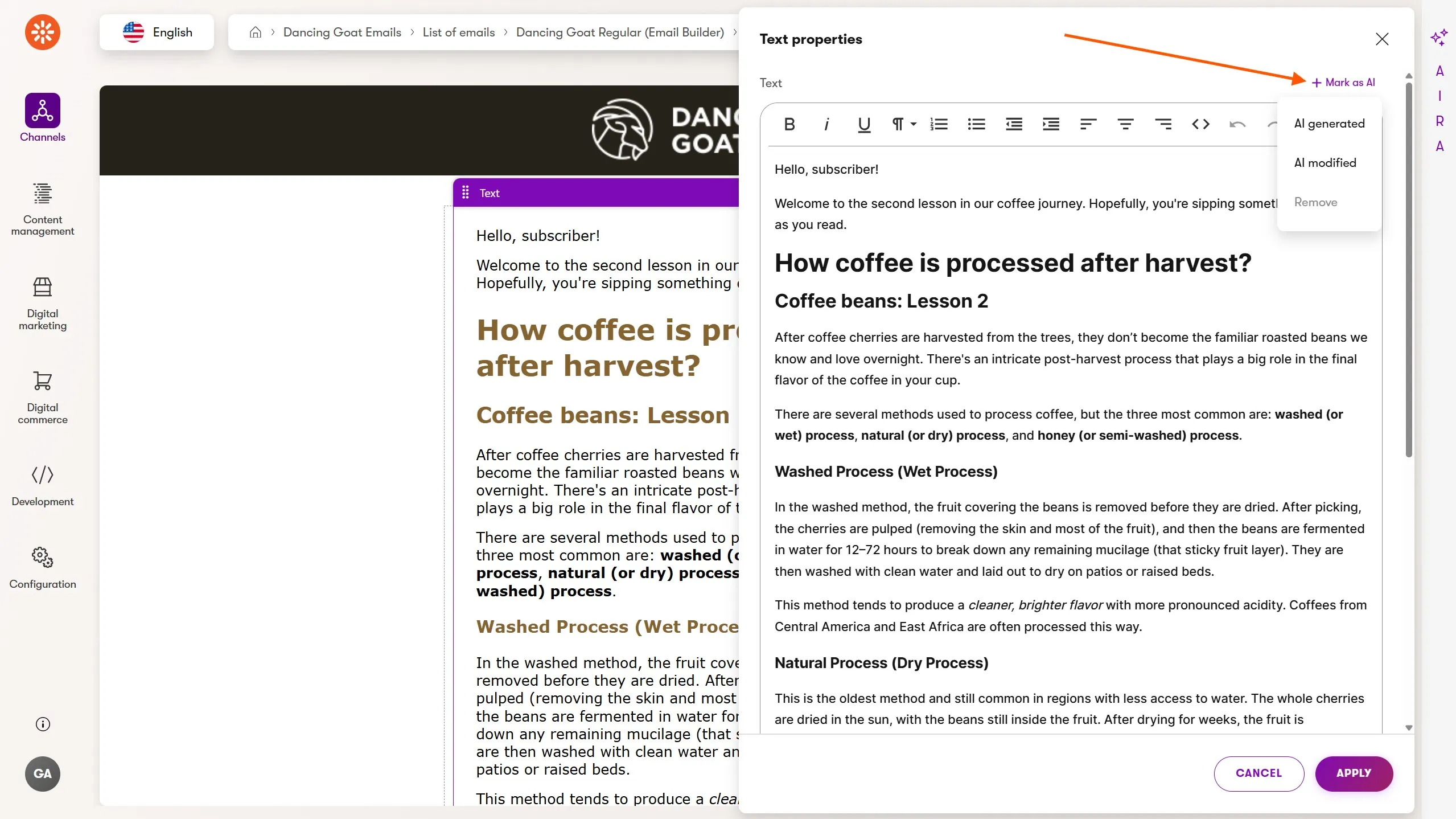
Xperience now enables users to mark text content as AI generated or modified directly in the editing interface.
Using AIRA's text refinement automatically updates the AI provenance label for the selected content. This content metadata is fully under the control of the content author to support additional scenarios:
- Content generated outside of Xperience and copied into a text field
- Content originally AI generated, but re-written by a human editor
Because an AI-generated or AI-modified attribute alone doesn't fulfill EU AI Act requirements, Xperience stores AI provenance data with the field. Developers can use it to tailor customer experiences for different audiences.
The data can be retrieved and rendered to fit the organization's brand and design requirements across website, email, and headless channels with no restrictions in presentation.
This is the first part of AI content marking; support for image assets will follow.
Better art direction with image variants in rich text content
Xperience's Content hub gives marketers the ability to organize, reuse, and deliver media assets across their digital channels. Image variants and AIRA's automatic focal point detection allow marketers to tailor their image library to the visual format of each customer experience.
Developers can use Xperience's native APIs and modern HTML and CSS to select and display the right variant for each page or device.
Unfortunately, for marketers working with rich text, image selection has been limited to the original image.
Now, marketers can select their preferred image variant when adding images to rich text fields.
When an Xperience application has at least one defined image variant, the rich text toolbar's insert image tool displays a Content hub panel with a variant selection option.
Marketers can quickly browse, filter, and select an image along with the right variant for the current location in their content.
Simpler content item deletion
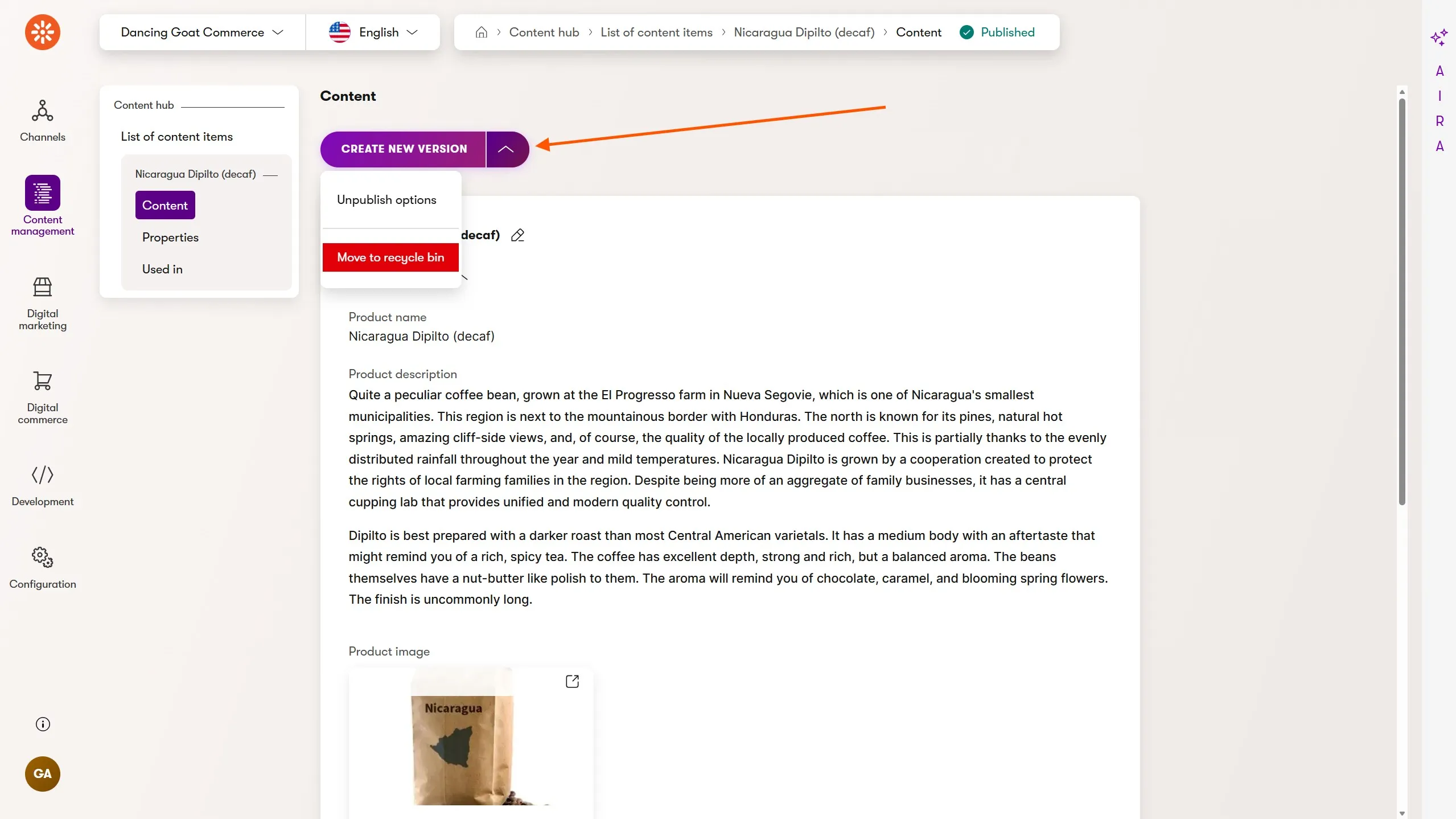
For marketers authoring and managing content in Xperience every day, a small improvement to your workflow has been included with the other larger features in this Refresh.
Previously, deleting a content item required clicking the trash can icon in the Content hub list view. Now, you can simply move a content item to the recycle bin from the content details view of that item with the split button dropdown menu.
Easier updates, fewer clicks.
Better insights from AIRA with an updated AI model
AIRA is Xperience's AI-powered agent available to marketers throughout the product. It helps them automate and streamline their work through AI-driven features and in-product guidance.
When AIRA features are added or improved, they become available to our customers through our monthly product Refreshes.
This month, we updated the AI model that powers the AIRA service after validating the model with automated evaluations.
For marketers, this means better responses from AIRA in features such as customer journey optimization, campaign report creation, and SEO/GEO analysis.
Because this improvement is delivered through the AIRA service, customers using Xperience versions released since the Agentic Marketing Suite launched earlier this year automatically receive the new model.
Robust SaaS security with authenticated origins and IP restrictions
Guarantees around data security and compliance certifications are some of the many reasons customers choose Xperience by Kentico SaaS for their Xperience projects.
That security focus includes internal observability for Kentico's global support team, as well as required MFA for Xperience Portal logins and user role management.
It also includes protecting customer Xperience applications hosted on Microsoft Azure with Cloudflare's CDN and firewall. The firewall is effective only when traffic to the Azure origin passes through it.
We now provide two additional security features that ensure all traffic passes through Cloudflare's CDN and firewall, even if attackers or bots discover the location of the Azure infrastructure.
- IP restrictions – a firewall in front of the application accepts inbound traffic only from Cloudflare's published IP ranges.
- Mutual TLS – Cloudflare presents a client certificate on every request to the "origin" application in Azure. The application validates the certificate and rejects invalid requests.
The animated visual above shows the layers of protection involved and various traffic scenarios.
Developers can opt existing applications into this additional protection with a single line of code. Any new Xperience by Kentico SaaS applications built on the October Refresh will include this code by default.
We plan to continue these security investments with single sign-on for the Xperience Portal.
Increased digital commerce conversions with cart item discounts
Xperience's digital commerce features are extensible, making it possible to model a business's commerce operations and unique customer buying experiences.
Xperience includes several native discounts and promotions:
- Catalog discounts
- Order discounts
- Free shipping (added in September's Refresh)
Teams can combine these promotions with Xperience's flexible content modeling, membership and customer management, and object extensibility to support additional scenarios. However, extensibility should be optional for common scenarios such as cart item discounts.
Store managers can now define cart item discounts, which are promotion rules that discount units the customer already has in the shopping cart, based on the content of the whole cart.
For example, "Buy 3 coffees, the cheapest is half price".
These discounts create cross-sell and upsell opportunities. Understanding customers' behavior and interests helps businesses create promotions that increase perceived value and generate revenue.
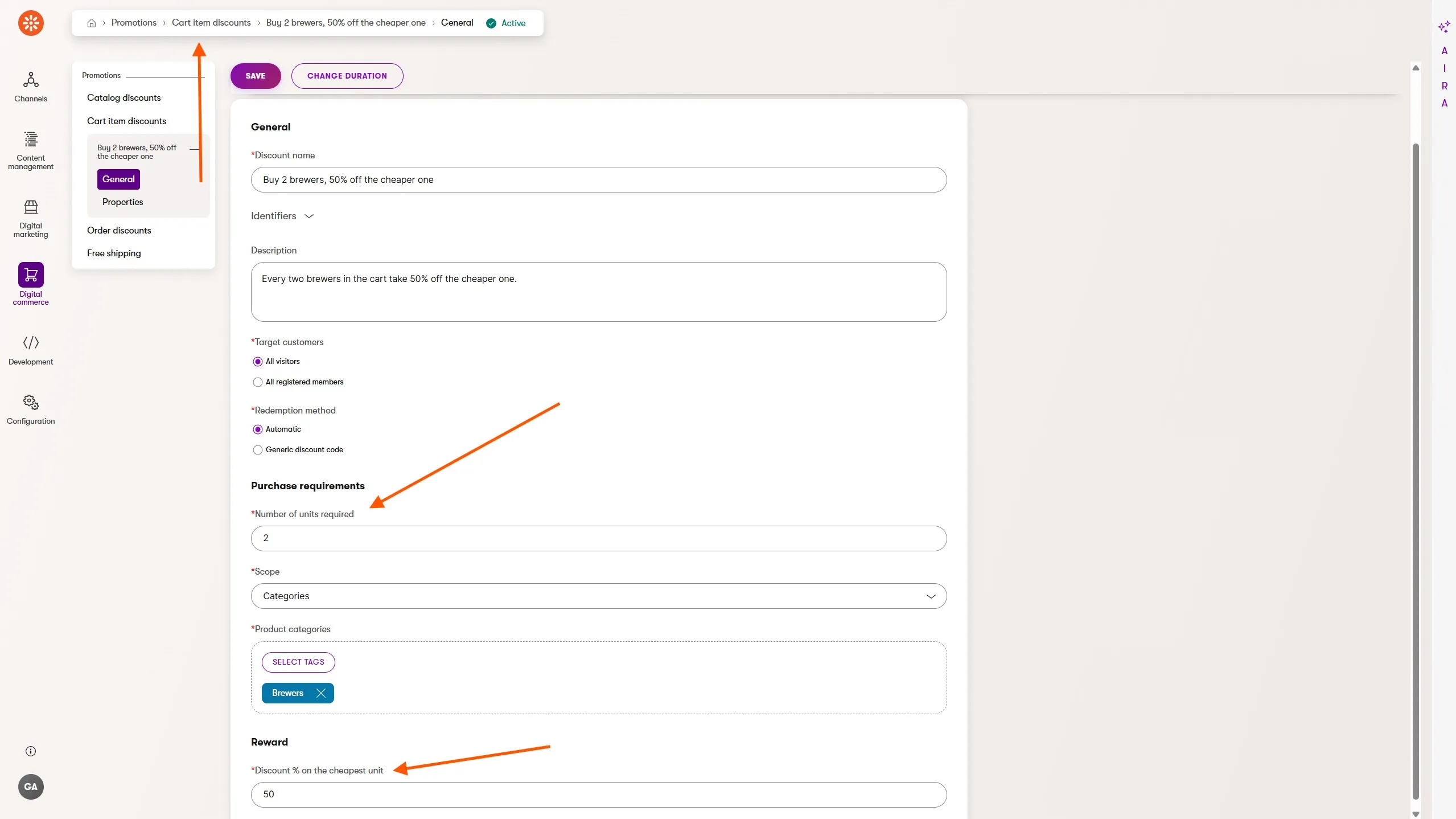
The properties form for each cart item promotion is extensible, as with other promotion types. You can use Xperience's UI form components to configure how your store's discount rules are calculated.
Watch the video above to see cart item discounts in action in our Dancing Goat application, from store administration to the customer experience.
If you are interested in digital commerce features in Xperience by Kentico, stay tuned for our planned update in November bringing free gift promotions.
Broader agentic development workflows with Management MCP server updates
One goal for Xperience by Kentico is to help customers bring digital experiences to market faster. Our developer community is rapidly adopting agentic software development to help achieve this.
Agentic software development requires that AI agents have high-quality context and the right tools. We're delivering a broader scope of tools each month through Xperience's Management API and MCP server.
October's Refresh brings a new set of tools and several smaller improvements to the Management MCP server.
The biggest update is support for forms, enabling AI agents to create, update, and delete forms and their fields. The video above shows an agent using the new tools to build a form from scratch in a Dancing Goat project.
This addition is another step toward autonomous, agent-driven website development guided by specifications and validation tests.
Additional updates include:
- Field Categories - UI forms of module class fields can be organized into categories.
- Tool search mode - This is for AI harnesses or clients that support it.
- Tool annotations - Tools now carry standard MCP annotations that mark read-only, destructive, and idempotent operations.
- Clearer startup diagnostics - When the server can't load tools from your application, its log now states the reason.
- Lower token usage - Tool results are now returned as compact JSON.
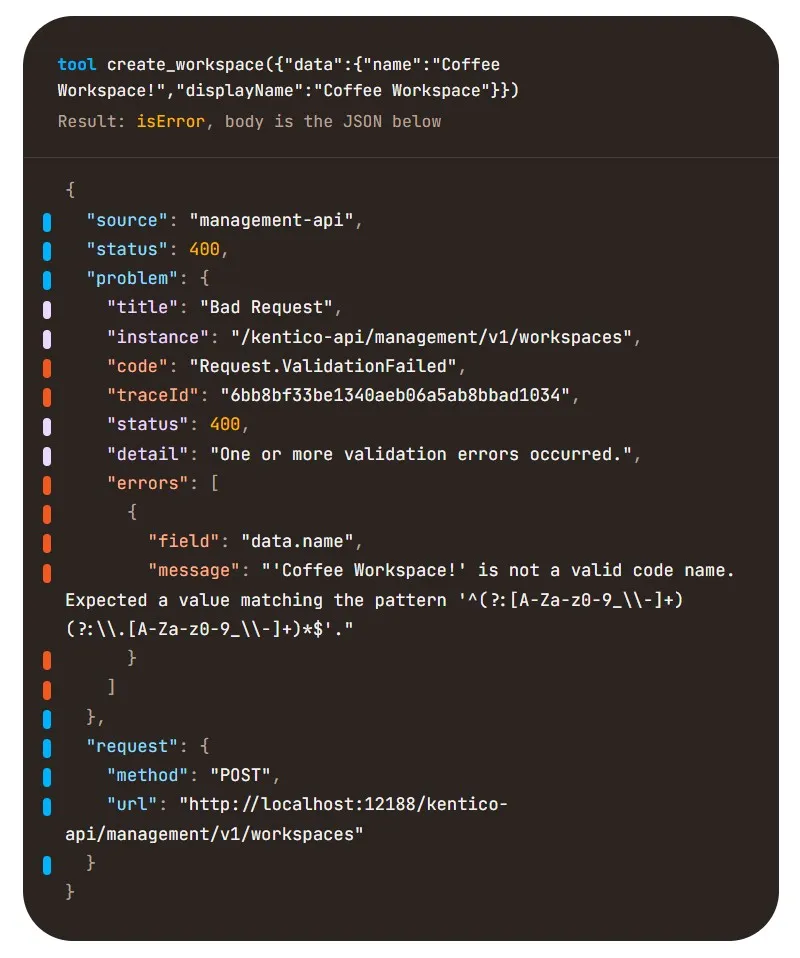
We also updated all Management API error responses to use the problem details error format, an industry-standard JSON response structure.
This helps agents understand and recover from errors. They can also provide consistent feedback about these scenarios through our Feedback MCP server.
What's next?
As always, check out our documentation Changelog for the full Refresh feature and technical details.
We hope these new capabilities, features, and API improvements unlock solutions for you. Try them out and let us know 👋 what you think.
What's planned for the next Refresh?
Use your own CDN and WAF for SaaS projects, letting SaaS customers use their own content delivery network and web application firewall.
Workspaces in forms, helping teams organize and manage forms in workspaces.
Digital Commerce - Free gift promotions, enabling promotions that offer customers a free gift.
These updates will, as always, accompany a number of UX and developer-focused improvements.
Check back soon for the next Xperience by Kentico Refresh review!
For the technical audience, this Refresh is represented by v31.10.0 of Xperience by Kentico.

Kentico Community
The Kentico Community